
PGA Coach Ian Bailey has been teaching people how to play golf for over 35 years. He has coached county-level players across Leicestershire and Rutland, and helped players achieve success in US college events, as well as top amateur tournaments in the UK
Over 20 years ago, Bailey helped to get Tri Golf up and running in schools – a version of the game that uses adapted equipment and child-friendly activities.
One of the highlights of Bailey’s work in schools was the installation of a six-hole short course at Maplewell Hall School, a school for children with special educational needs.
Bailey, who became a PGA Professional in 1984, prides himself on being able to teach at the grassroots level and the elite. He is well-placed to advise other coaches that the way forwards is to specialise in one area of coaching as much as possible.
Here, Bailey talks us through how to do this, why it can be preferred over the multi-tasking nature of a Head Club Professional, and how to carry over coaching skills from one specialist area to another.
Pictured: PGA Coach Ian Bailey delivering a junior group class at Kirby Muxloe Golf Club
Become a specialist coach
When I started, the club pro was a master of all trades. It was difficult to keep all those hats spinning. Nowadays, I'd recommend people specialise and I’ve become a specialist coach now, rather than a club professional, I just coach full time. I really enjoy it.
If somebody has got aspirations of helping, I'd contact the PGA through the website or through the national course at The Belfry and speak to relevant people in the training department, to understand what the processes are to get on the first rung of the ladder.
If you're having lessons with a pro, ask him or her if you can chaperone, just watch what they do.
Coaching is wonderful, seeing how you can help somebody get better.
“When I started, the club pro was a master of all trades. It was difficult to keep all those hats spinning. Nowadays, I'd recommend people to specialise” - Ian Bailey
Be enthusiastic and adaptable
It’s very important that the coach is enthusiastic, but the coach has got the ability to adapt to the person in front of them.
I pride myself that I can work with a beginner. I do a lot of work in special needs as well at an autistic school, and then in a heartbeat, I could work with an elite player. Obviously, it's a different approach, but the basics of the game are the same.
Every shot has got an address and posture position which covers your club alignment, your grip, your stance, your ball position, and your posture. So regardless of abilities, that's your starting point, and then you just progress your coaching, depending on how the player moves, their ability from the ground up, and also their ability with the club.
You never stop learning and I think it’s important that you have that mentality.
You're always striving to get better at whatever you're doing. So whether that's going on courses, whether it's going into different environments, and that's something I would recommend as a coach.
I pride myself that I can go from one environment to another very quickly, and I've learned that through the different environments I've worked in. It's made me a better coach today, but it's the reward of seeing somebody improving at what they love to do with a little bit of help from somebody like myself.
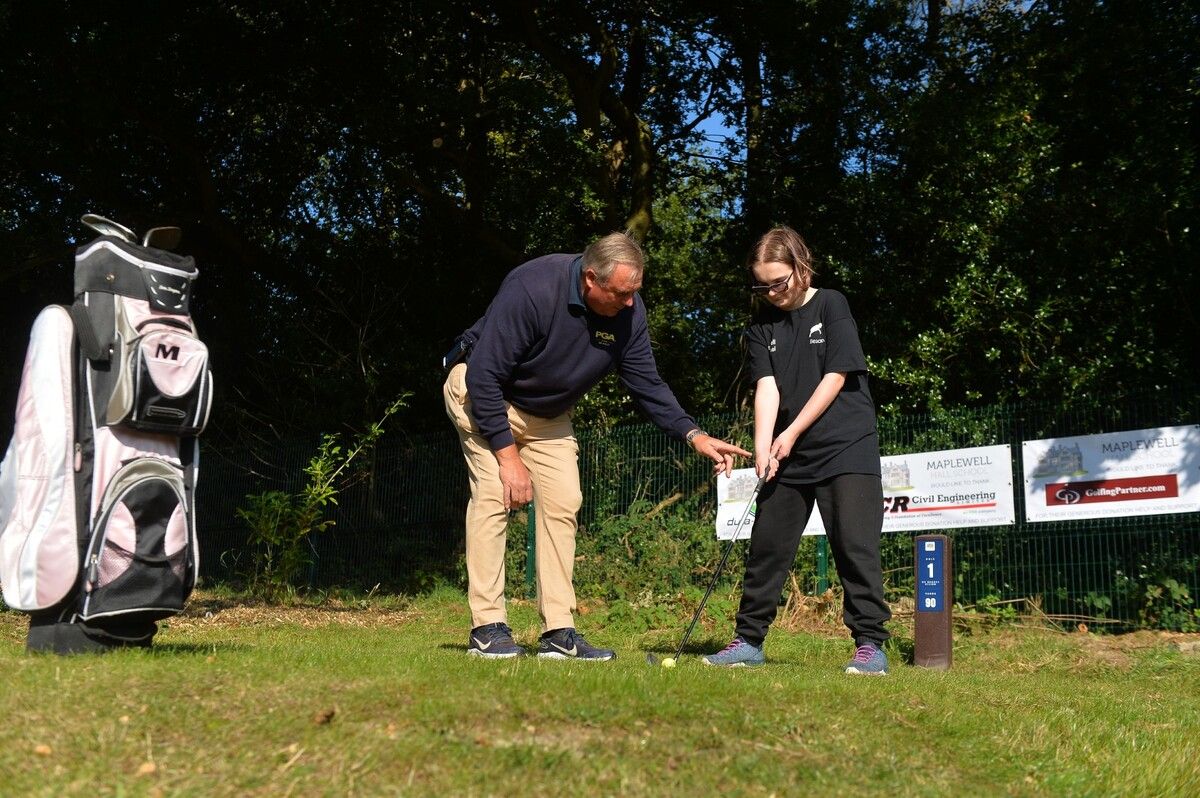
Pictured: PGA Coach Ian Bailey with juniors at Maplewell Hall School
Coach in schools
I started in 2003 doing some work for Leicestershire City Council with Tri Golf, which is plastic clubs and foam balls. Started doing a Schools Project, which was three schools initially, and we grew it to 2019 where there was 24 schools, and also integrated special needs and disability as well.
It was a huge success. We're getting over 1000 pupils having a go at Tri Golf every year, and it culminated in festivals, two festivals, one either side of the city, and it was brilliant. But as a coach again, you get to go into different environments, and you get to think quickly, so it tests your coaching.
From there, through a friend who's a head teacher at Maplewell School, which is an autistic school in Leicestershire, he asked me to do some coaching. I'm now on the school curriculum, going every Wednesday. We've had a six-hole par 3 course built as well.
Golf is a great sport at all levels, so whether it's coaching, playing, even watching, it's a great sport. And from my point of view, I enjoy the challenge of working with a person in front of me. I've got to adapt to that regardless of the environment, but the basic rules of coaching are the same.
Interested in coaching juniors? Check out or range of junior coaching resources, available via PGA Learn.