
PGA Coach Alex Buckner has had a year to remember, helping England’s Marco Penge to great success on the DP World Tour
Penge has come of age in 2025, winning three times and competing at the top of the Race to Dubai – a stark contrast to 2024 when he only just kept his playing rights.
Buckner, who has held coaching roles at Swinley Forest, Eton College and currently Bearwood Lakes, oversees Penge’s swing and short game.
Here, he describes his meticulous approach and explains how and why he sets goals for the players he works with, the use of stats, coping with pressure, and why improvement should be the aim over winning.
Trophies versus progress
A lot of people fall into the trap of trying to win the golf tournament that's right in front of them, versus how we get better in five months’ time. A lot of what we're trying to do is work on a certain style of shots that he wants to be better at in order to perform better.
He's not only working on them, he's also then trying them out on the golf course and as much as they might not be the right shot, because he's not very good at that shot, it's also the right shot in the scenario, if he was to be able to pull it off.
As a result, we might have thrown away some better results, but in the long-term strategy, he'll be a much better player in a year's time because of what he's doing.
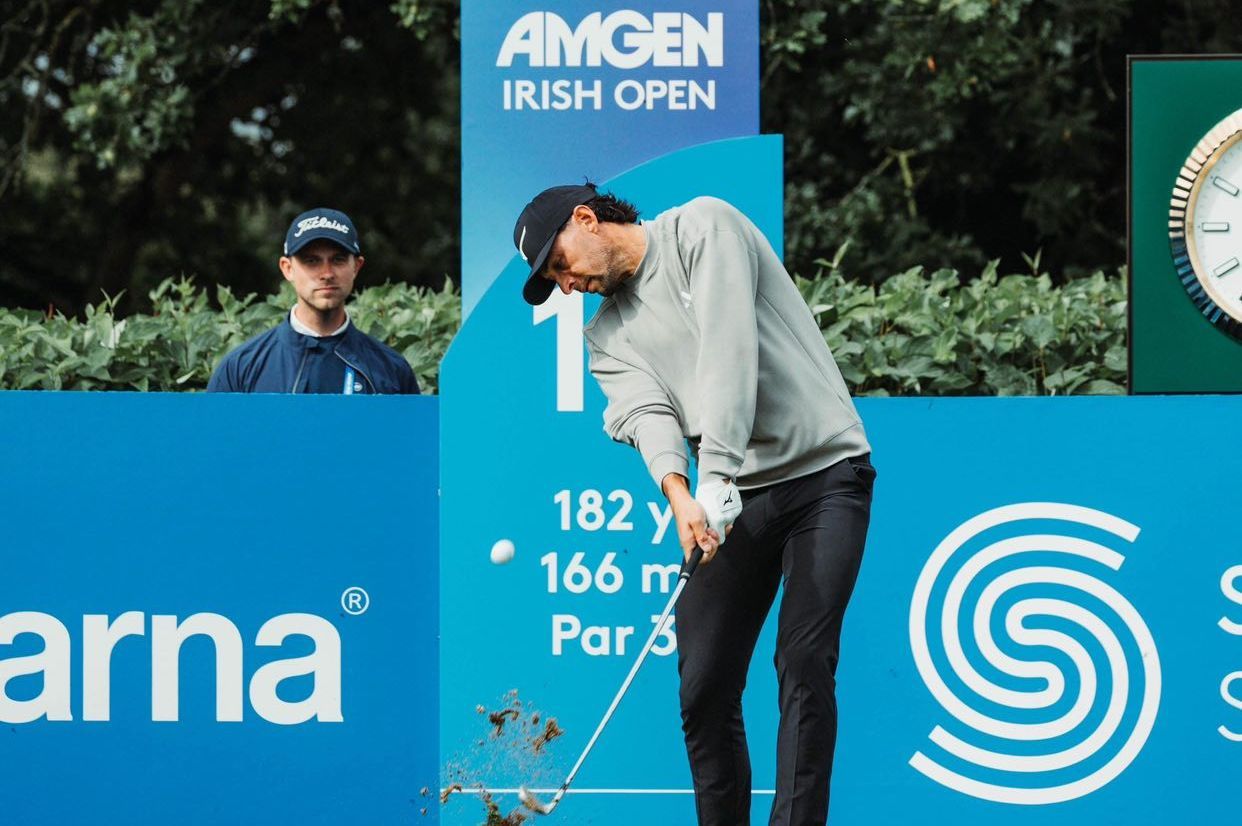
PGA Coach Alex Buckner working with Marco Penge
Do you set goals for a player?
Yes, absolutely, then dissect down into process goals. Without an understanding of what goals you have, there's no real direction in what you're trying to do and where you're trying to go.
The goals might be like in approach play, we would love to get better at shaping it into left to right flags while leaving it on that side of the flag.
It could be making sure that distance control is better to flags at the back, rather than airmailing them or taking spin off onto the green and being able to get the ball to only hop and stop rather than draw back in 10 yards.
Why and how to use statistics
We use a lot of statistics. It is to guide what you're trying to do. His (Penge) approach play is very on and off and as a result, (we ask) why?
We look at certain flags. He misses on the short side on left to right flags too much. He goes over the back too many times on back flags and with wedges, where he pitches the golf ball is close to the hole, but where the ball then finishes is not good enough in proximity to the hole.
Because of those stats, we're allowed to ask good questions. With good questions, we can get feedback on why we recommend stats. We’ll get some evidence from the caddie as well as Marco to suggest why we're seeing those stats, and then we can say how we are going to get better.
"As a result, we might have thrown away some better results, but in the long-term strategy, he'll be a much better player in a year's time because of what he's doing" - Alex Buckner
Online techniques
We’d send videos through WhatsApp, and use analysis on Skillest to look at things.
Whenever that would happen, I'd personally only to use it for a question on how to understand function a bit better. There's not loads you can do online. As much as people say it will take over, the reality is you can't hear the strike on the club. You can't see the depth in the divot, you're having to actually assume a lot of whatever the player is telling you that's happened.
You can't see the ball flight really either. You get these videos of these swings or actions, and you don't really know the context of what shot they're trying to produce, where it came out on the face, how much did it spin, what was the trajectory?
In person, if they've interpreted wrong, you can just say I wanted you to do this… You can physically keep your hands on them and move them around. But online, you tell them something, and they can interpret it wrong.
PGA Coach Alex Buckner working with Marco Penge in Dubai
Dealing with setbacks on tour
How you cope with it is to strip everything back. A lot of players are completely reactional, down to trying to win the tournament this week, or trying to not suck or not make it fall out of themselves.
There’s this thing of, ‘Where’s the magic pill?’ versus ‘How do you get better at every department of the game?’, and I don't mean just putting, chipping, approach play and long game.
I mean your caddie conversation, your prep for tournaments, your routine, what you do in the gym, and equipment. Look at everything. If we can get 2 or 3% better in every department, even if you weren't to play well, you'd actually be a lot better than what you currently are.
Coping with pressure
A lot of it is mental and rhythm-related. If their heartbeat goes faster, how do they deal with that? What happens to their rhythm? What happens to their tension? Do they completely understand the feedback loop of if they were to hit a certain bad shot, why has that happened?
They can completely own their golf swing in the scenario because a lot of the time when pressure happens, you'll ask yourself: Can I do this? If there isn't really an answer that you give yourself, you go into panic quite quickly.
Autopilot is one of life's best things. But when pressure happens, autopilot disappears, and if you don't really have an answer to it, then you do completely lose yourself in how to do something.
When dealing under pressure, it's not about immediately winning. It's about,'What would you be happy with, despite the result?'


