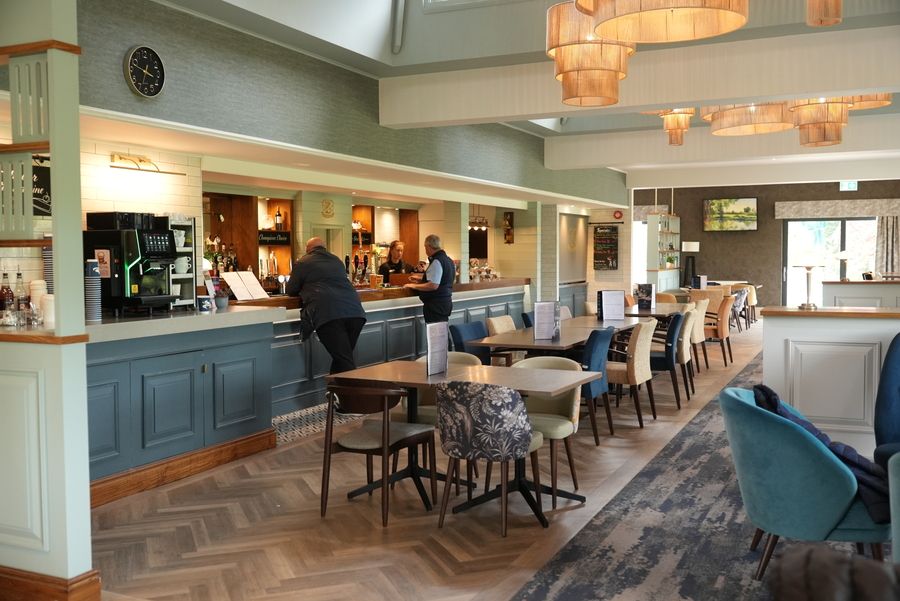



Brendan McDermott, Data Analyst for Capital and Asset Management at Club Benchmarking, explores why some golf clubs may be missing the mark with how they utilise their clubhouses.
Walk into almost any golf club in Britain or Ireland and you will find the same conversation happening somewhere between the bar and the boardroom. Food and beverage is losing money. The kitchen is underperforming. Members are complaining. Someone suggests bringing in a franchise operator. Someone else suggests hiring a new head chef. The cycle repeats.
But what if the problem is not the food? What if it is not the chef, the menu, the supplier, or the service standard? What if the real problem is that golf clubs have been trying to run something that is fundamentally not a restaurant as though it were one?
That is the argument at the heart of a new leadership framework developed for the golf and private members' club sector. And once you see it clearly, it is difficult to unsee.
"The clubhouse is not a revenue centre. It is a value centre – and there is a profound difference."
We have been measuring the wrong things
For decades, golf clubs have evaluated their food and beverage operations using metrics borrowed from the commercial restaurant industry. Gross profit percentages. Labour cost ratios. Revenue per cover. Break-even targets.
The logic seems reasonable on the surface. The clubhouse has a kitchen. It has tables. It serves food. So measure it like a restaurant. The problem is that a golf club is not a restaurant – not in its purpose, its economics, its audience, or its culture. Applying restaurant metrics to a members' club creates what leadership theorist Keith Grint would call a category error: attempting to solve the wrong kind of problem with the wrong kind of tools.
Research backs this up. Data from Club Benchmarking shows that 65% of golf clubs in the UK and Ireland operate with a food and beverage deficit. In the United States, that figure rises to 75% among top-performing clubs. These are not failing operations. These are clubs that understand what their food and beverage function is actually for.
The clubhouse as social engine
Ask a golfer why they chose their club and they will rarely mention the menu. They will talk about the course, the community, the people they play with, and the atmosphere after a round. The clubhouse is where all of that comes together.
Think about the journey of a typical golf day. A member arrives, meets their playing partners, has a coffee before the round. They play. They come back. They sit down together, still in their spikes, replaying shots, laughing about the back nine. That post-round ritual is one of the most valuable moments in golf club life. It is where friendships deepen, where members renew their sense of belonging, where the club becomes more than just a place to play.
The clubhouse exists to serve that journey. It is the social engine of the club. Its job is not to generate a surplus on food sales. Its job is to extend and enrich the golf experience, before the round, after it, and in all the spaces in between.
"The deficit is not a sign of failure. It is a sign of investment in community, satisfaction, and retention."
Think household, not restaurant
A more useful comparison than the restaurant is the household. At home, we do not evaluate the kitchen on whether it turns a profit. We invest in food because it brings people together, because meals are a form of care, of connection, of shared ritual. We do not measure the return on investment of family dinner.
Club members, at their best, are co-owners of a shared home. They pay their subscriptions and food minimums not as consumers purchasing a service, but as participants investing in a culture. The clubhouse is their shared table.
When something goes wrong at home – a meal that does not land, the kitchen needs reorganising – the response is not to outsource the cooking or fire the cook. It is to adapt, support, and improve together. Clubs that understand this operate with a fundamentally different relationship to their food and beverage teams.
Where clubs go wrong
Most clubs that struggle with food and beverage are making one or more of the following errors:
-
Formal over informal. Overinvesting in formal dining while underinvesting in social space. Large dining rooms with full table service sit half empty while members congregate around the bar or outside. Golfers coming off the course want ease and informality; quick service, comfortable seating, somewhere to debrief. Formal dining, however excellent, is not what drives day-to-day clubhouse culture.
-
Events vs. daily service. Judging everyday service by the standard of events. A Saturday gala dinner runs like clockwork; scripted, staffed, rehearsed. It is theatre. Wednesday lunch is jazz. Unpredictable footfall, varied preferences, no script. Holding daily service to the same standard as a planned event creates impossible expectations and demoralises teams that are actually performing well.
-
Mistaking volume for validity. Listening to the wrong voices. Research on service experience shows that frequent users generate the most feedback – not because they are the most dissatisfied, but because they have the most exposure. A member who visits the club five times a week will encounter more inconsistencies than one who comes once a month. Their complaints often reflect care and ownership rather than genuine failure. Clubs that redesign their operations around the loudest voices rather than the broadest membership risk chasing outliers at the expense of the silent majority who are quietly content.
Why outsourcing is not the answer
When food and beverage performance disappoints, one solution that frequently surfaces is franchising the kitchen to an external operator. On paper it appears clean: remove the management headache, let professionals run it, protect the club from financial risk.
In practice, it rarely works and often makes things worse.
The franchise model creates a structural misalignment from day one. An external operator is optimising for their own margins. The club is trying to optimise for member experience. These two objectives frequently conflict – on opening hours, pricing, menu design, staffing practices, and quality standards.
There is also the infrastructure problem. The club typically retains responsibility for utilities, equipment maintenance, and repairs. If the kitchen equipment is ageing, the cost falls on the club, while control of the operation does not. The club assumes financial exposure without operational authority.
And then there is what might be called the honeymoon effect. A new operator, like a new head chef, generates a brief period of renewed member interest. Standards feel fresh. The complaints quieten temporarily. But members are creatures of habit, and within a season they return to their patterns. The same expectations – five-star quality at accessible prices – reassert themselves. The underlying tension was never resolved. It was merely deferred.
"Franchising the kitchen does not solve the problem. It relocates it – while surrendering control."
The governance question
Behind many of the operational problems in club food and beverage lies a governance problem that rarely gets named directly.
Boards and committees apply pressure on food and beverage operations as though the membership pool is unlimited; as though standards can always be raised, expectations always escalated, performance always improved without consequence. But clubs operate within a finite system. There is a fixed number of members. A fixed number of visitors. A finite and relatively predictable pattern of spend.
When boards apply infinite pressure to that finite resource, demanding commercial restaurant performance from a subsidised community service, rotating managers when targets are missed, chasing break-even at the expense of culture, they do not improve the operation. They exhaust their teams, destabilise their kitchens, and gradually erode the very atmosphere that retains members in the first place.
The most effective boards treat food and beverage as infrastructure. They ask not whether F&B is profitable, but whether it is performing its actual function: keeping members engaged, returning, and proud of their club. That requires a different set of questions, and a different set of metrics.
What good looks like
The clubs that get this right share some common characteristics. Their approach is less about fine dining and more about fine belonging.
-
Redesign around the golf journey. Design for golfers first. Layout, service style, and opening hours should prioritise players coming straight off the course. Spikes welcome. Fast service the default. Outdoor flow from the 18th green to a comfortable terrace matters more than a formal dining room with white tablecloths.
-
Simplify the food offering. A shorter menu executed consistently is worth far more than an ambitious menu that creates pressure on the kitchen and disappointment in the member. Clubs that have simplified their food offering typically see both cost reduction and satisfaction improvement.
-
Invest in bar culture and social space. In most golf clubs, the bar drives more culture than the kitchen. Investment in atmosphere, a well-run bar team, and comfortable informal seating returns more in member satisfaction and dwell time than investment in kitchen complexity.
-
Measure what matters. Replace gross profit percentage and break-even targets with metrics that reflect what the clubhouse is for: dining Net Promoter Score, member return visit frequency, event participation rates, staff retention in F&B, and member advocacy. These tell a truer story.
-
Keep the golf in the clubhouse. Show major tournaments on screen. Create moments for members to gather around the game they love. A club that watches The Open together builds something a restaurant never can.
-
Listen broadly, not loudly. Engage members in feedback through structured channels – pulse surveys, QR codes, member apps – rather than allowing a vocal minority to shape operational decisions. Use the Pareto principle: the 80% who are quietly satisfied matter as much as the 20% who are loudly critical.
-
Train and invest in your people. The most overlooked investment in club food and beverage is not equipment or menu design; it is the team delivering the experience every day. Clubs that invest in staff development see returns that no kitchen refurbishment can match: confident employees, lower turnover, and a service culture that members feel the moment they walk through the door. Numerous organisations within the private club industry have made this their mission. These organisations offer structured hospitality training programs in the private club industry. These programs can significantly alter how a team performs and how they feel valued within the club for as little as three pounds per member. Staff members who are empowered not only serve members but also represent the club's culture. The value of that is significantly higher than the amount that was invested.
Culture on a plate
The argument here is not that food and beverage does not matter. It matters enormously. A poorly run clubhouse – slow service, poor quality, an atmosphere that feels unwelcoming – can drive members away as surely as a bad course.
The argument is that the way most clubs have been thinking about it is wrong. They have been asking whether the kitchen makes money when they should be asking whether the clubhouse makes members feel at home.
The clubhouse is not a restaurant. It is something more complex, more human, and more valuable than that. It is where a round of golf becomes a memory. Where strangers become playing partners. Where the culture of the club is made and remade, season after season.
Lead it accordingly.