
In May, the PGA Championship will return to Aronimink Golf Club in Pennsylvania for only the second time in the tournament’s history.
Hundreds of thousands of spectators will descend upon the venue, just to the west of Philadelphia, to find out if defending champion Scottie Scheffler can retain the Wanamaker Trophy, which he won in May last year.
The likes of Rory McIlroy, Bryson DeChambeau and Jon Rahm will also hope to have a tilt at one of the four major championships in the men’s game, and the second one in the season’s calendar, following the Masters.
In the lead-up to May 14, when the tournament kicks off, the spotlight will fall not only on which players are in form, but also on the operation behind the scenes at the venue and the preparation required to hold a major championship.
At the centre of that operation is a man originally from Longniddry, in East Lothian. Andrew Whitelaw is the General Manager of Aronimink and a PGA Advanced Fellow Manager.
His career journey reflects both the global reach of PGA Members from Great Britain and Ireland and the diverse career opportunities available within the industry.
“I lived right next to Longniddry Golf Club in Scotland, so it was natural for me to take up the game. We had an amazing junior section with six of us from the same age group all becoming PGA Professionals. The competition and the camaraderie in the group was certainly a major factor in me choosing to set out on the path to becoming a PGA Professional.
“I grew up and had my primary school education in the Far East, moving home for senior school when I was 11, so I had always travelled and the lure and excitement of doing this again was in my blood and was always something I wanted to do.”
From his early days studying at the University of Stirling and in assistant professional roles through to leadership positions at Emirates Golf Club, Trump International Golf Club Dubai and Portmarnock, Whitelaw has forged a career path that has led him to the hot seat of a major championship venue.
“My path to Aronimink really reflects the journey a lot of PGA Professionals take starting on the teaching and playing side, then gradually discovering a passion for the business and operational side of the business. I came up through Assistant Professional roles at private clubs, worked my way into Head Professional positions, and along the way kept gravitating toward the management side of the business.
“When the opportunity at Aronimink became available, it felt like the right convergence of all my years of experience. It’s a club with an extraordinary legacy, a membership that truly loves the game and their club, and a facility that operates at the very highest level. That was compelling to me.”
Experience and learnings from the PGA pathway still influence Whitelaw’s role at Aronimink today, as he continues to lean on key aspects of management and leadership to steer the club through its preparation for major week.
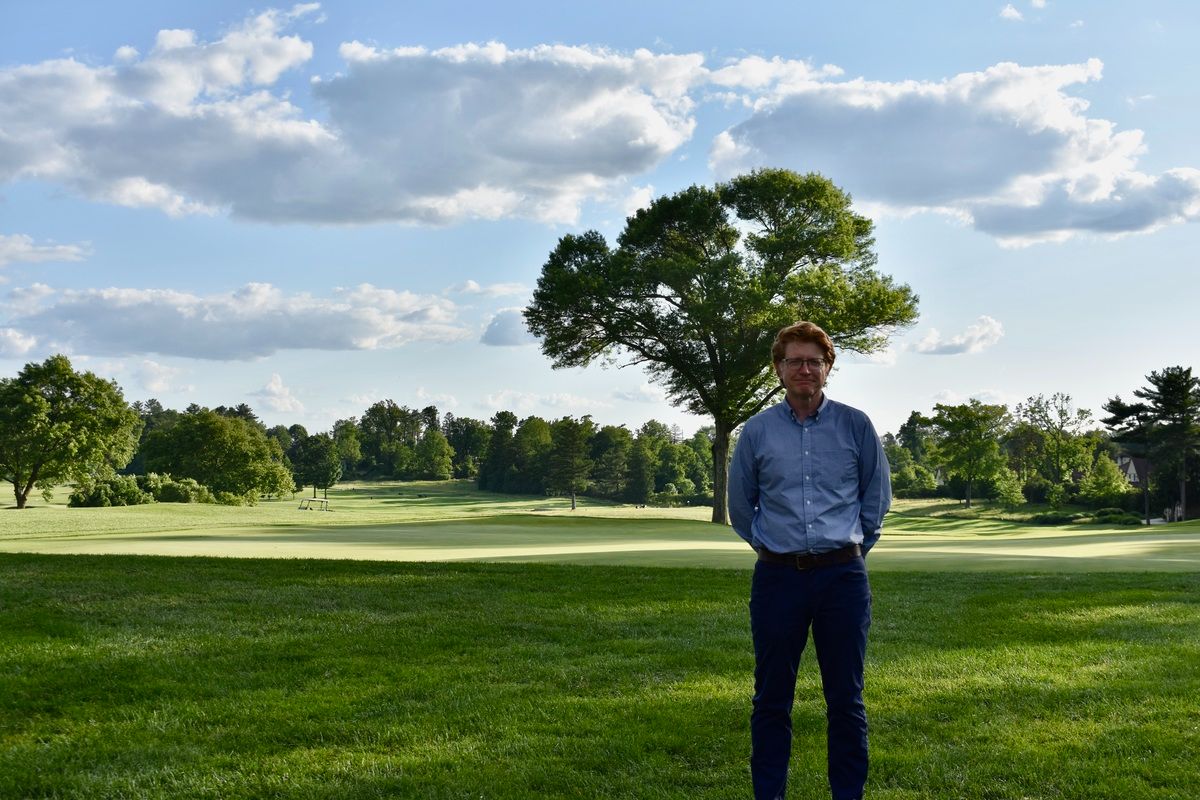
Pictured: PGA Advanced Fellow Manager and Aronimink General Manager Andrew Whitelaw
“The PGA’s education framework is genuinely extremely well-suited to help you develop as a General Manager. What it instilled in me early was discipline around the fundamentals of management, leading and developing teams but more than technical knowledge, it shaped how I think about service.
“Golf club management is hospitality at its core, and the PGA teaches you to approach every interaction as an opportunity to elevate someone’s experience. That mindset translates to every corner of the club business.”
As Aronimink transitions from normal club operations into major championship mode, the scale of change is significant. This private members’ club has been required to shapeshift into a global sporting venue again, having also hosted PGA Tour events and the Women’s PGA Championship in 2020. It requires meticulous planning and coordination across every area of the business.
“Almost everything shifts, but the most dramatic changes happen in infrastructure, staffing, and member communication. You’re essentially building a temporary city on the grounds: hospitality structures, media facilities, security perimeters, transportation logistics to name a few,” Whitelaw said.
“The golf course itself goes through an intensive preparation process that’s months in the making. And then internally, you have to manage the member experience through all of that disruption with a lot of transparency.”
Central to delivering an event of this scale is a close working relationship with the PGA of America, the organisation that also runs the Ryder Cup when it is held in the USA.
“It’s genuinely a partnership and a very close one. We have regular touchpoints with the PGA of America’s championship staff that increase in frequency as we approach the event. They bring enormous expertise in running these events, so there’s a lot of trust in their systems.
“Our role is really to be the best possible host venue, to know our facility inside and out, to facilitate our joint vision for the championship by making sure the on-site experience reflects the standards of our club. It’s collaborative rather than directive, which I think brings out the best in both organisations.”
An important feature behind the scenes of hosting a major tournament is the effort to bring multiple departments together to work towards the common goal of delivering the best event possible. Whitelaw described how his team have worked to leave no stone unturned.
“Early alignment around a shared vision is everything. We start those conversations long before the event is close, so that every department whether it be in food and beverage, grounds, security, facilities, and communications understands not just their own responsibilities but how their piece connects to the bigger picture.
“We use structured planning meetings, shared timelines, and clear escalation paths so nothing falls through the cracks. But honestly, culture matters as much as process. When your team genuinely takes pride in what the club represents and what this event means, the coordination becomes much more natural.”
That team extends beyond full-time staff, too, with volunteers playing a crucial role in the overall experience for players, members and spectators.
“They’re absolutely essential, you simply cannot run an event of this scale without a large, well-briefed volunteer program. Volunteers in particular bring passion and enthusiasm that’s infectious,” Whitelaw continued.
“Many of them are golfers themselves – members of the broader golf community who want to be part of history. Our job is to prepare them well, make them feel valued, and give them clear ownership of their roles. A well-briefed volunteer who knows their area and feels empowered to help spectators is one of the best ambassadors the event can have.”
As well as coordinating an army of volunteers, the logistical challenges involved in hosting a major championship are vast, ranging from infrastructure and course preparation to managing relationships with members, local communities and external stakeholders.
“Infrastructure lead time and the amount of disruption is one of the most underestimated challenges. The amount of time needed for temporary construction tenting, utilities, signage, and transportation routing requires planning that starts years out and that’s dealt with by the PGA team. The golf course preparation is its own discipline entirely, working backward from peak condition on championship week through all the traffic and disruption of setup and here in Philadelphia, we have a long winter to contend with as well.
“And then there’s the human element managing the expectations of members, communicating with neighbours and the surrounding community, coordinating with local municipalities on traffic and public safety. No single piece is impossible; it’s the coordination of all of it that requires real discipline.”
To operate at this level, whereby you are gearing up to host the best players on the planet and thousands of spectators and officials onsite across a week, Whitelaw believes the combination of both sporting knowledge and experience in business is vitally important.
“They’re inseparable in this context. The golf knowledge gives you credibility with your team, with the PGA of America, with your membership. You can have a real conversation about course setup philosophy, about how playing conditions will affect the championship narrative, about what the players and caddies will need. Business knowledge keeps all of that grounded in operational reality budgets, contracts, risk management, and staff capacity.”
• The 108th PGA Championship will take place at Aronimink Golf Club, in Pennsylvania, from May 14 to 17. Click here to learn more