

From major champions and Ryder Cup stars to everyday club golfers, PGA Master Professional Phil Kenyon has helped players at every level find success on the greens. Here, one of the game’s leading putting coaches explains the outlines the foundations of performance and why the greatest reward comes from helping others succeed.
Phil Kenyon’s reputation as one of golf’s leading putting coaches has been forged through his work with some of the biggest names in the game.
The PGA Master Professional has helped stars including Scottie Scheffler, Rory McIlroy, Brooks Koepka, Tommy Fleetwood, Justin Rose and Matt Fitzpatrick unlock improvements on the greens, playing a role in and achieving success at the highest level of the sport.
Kenyon’s portfolio of players is certainly strong, but in both the professional and recreational game, putting has a significant influence on your scorecard after 18 holes. Kenyon believes there are three crucial departments in putting that are relevant across all abilities.
“When you look at it from a putting perspective, performance is influenced by start line, speed and green reading. So the non-negotiables are addressing those skills, making sure that you're competent in those skills, and there's a variety of different approaches that you can take to develop skill in those different areas,” he told The PGA.
“Whenever anyone comes and presents themselves for a lesson, you're dealing with very different individuals, and there could be different ways to go about it, but ultimately, you're guiding them towards being more skilful in those three areas.
“There are different ways to achieve them, different strokes for different folks effectively, but you have to be able to develop skill in those three areas.
“When someone comes to a lesson, you always have a conversation,” he added. “Try and appreciate what the player is experiencing, what they're looking to improve, the thoughts that they may have, and then you observe them and try and structure the assessment to really help assess their ability in those three skills.
“Sometimes what they think they're doing isn't what they're actually doing, so you have to try to provide the evidence to support what you suggest that they need to do, because it could be contradictory to what they believe.
“It can be a challenge when you just have a recreational golfer coming for a one or two-hour lesson, because you are having to make an assessment of a player in a very short period of time. Whereas, if you're working with an elite player, that assessment is built up over a bigger period of time, through more observation.
“The assessment therefore is really important to allow you to really determine what the player is doing, and therefore how you can help them.”
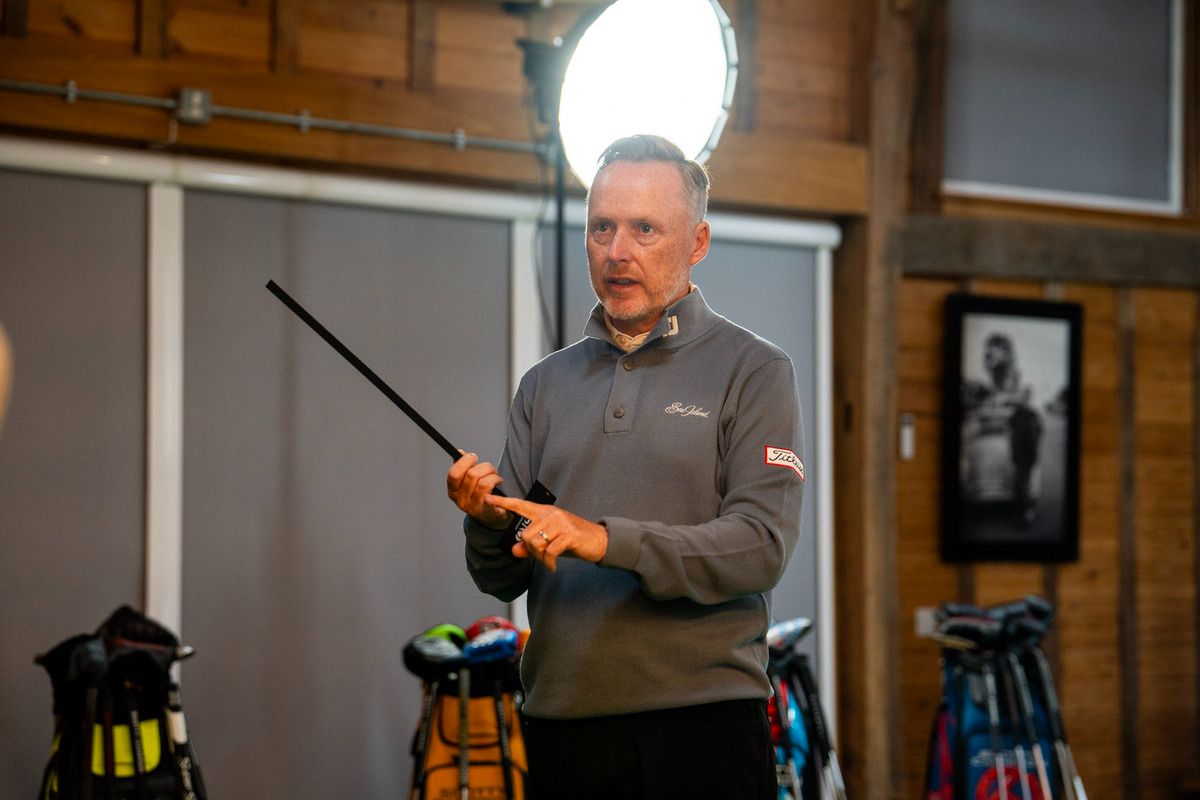
Pictured: Phil Kenyon
With a client list that reads like a who’s who of the game, Kenyon’s background and passion for coaching spreads across golf’s ability spectrum.
Whether working with tour winners inside the ropes or helping club golfers shave a few shots off their handicap at his base in Formby Hall, near Southport, for Kenyon, the reward comes from helping people improve, building relationships and seeing golfers of every ability achieve their goals.
“There's obviously different elements of your job which you can find more satisfactory,” he said. “For me a lot of it is the personal relationships you build up with people and then being able to help them achieve their goals, that brings a tremendous amount of satisfaction.
“When you're working with a player who's passionate to improve and they see progress, and they work really well with you, they're engaged, they listen to what you say, they go away, they do the work, they feedback, and then they're having success – that's just rewarding, no matter what level it is.
“The relationships that you have on the journey, the shared experiences, the shared moments with that player – it could be a young kid that you're helping whose been picked for England, or it could be a tour player who wins an event – they’re all good experiences and I think that’s why I've always enjoyed coaching. You get to ride on the back of other people's success.
“I always remember when I packed in playing and I went to work with Harold Swash, and I started coaching. It was the first time I went home after the end of a day's work and felt really good about myself. I noticed a tangible difference to my mood, just because of the environment I was in, helping people get better.
“Golf can be such a miserable game at times, because you can work so hard and get nothing out of it. You go and play poorly and judge yourself by your score all the time. As soon as you're involved in coaching, I just found it so much better for my own mental health. Being around people, helping people no matter what level, when that goes well, it’s massively rewarding.”
Kenyon began his golf journey as a player for England Schoolboys, then progressed through the ranks to play on the PGA EuroPro Tour, then the Challenge Tour – what is now called the Hotel Planner Tour.
It was in 2005 when he stopped playing and joined Harold Swash’s academy full-time. Swash was a friend of Kenyon’s father, and had coached putting to Sir Nick Faldo, Padraig Harrington, Darren Clarke and Lee Westwood.
Kenyon emphasises how important it is to have a mentor to learn from, which he had the benefit of with Swash. Swash was once known as ‘Britain’s Putting Doctor’. At the start, Kenyon took on some of his clients, which led to working with Fleetwood for the first time. Swash passed away in 2016 at the age of 83.
As well as finding a mentor to learn your trade, Kenyon also encourages other PGA Coaches to give as many lessons as possible, to gradually build the knowledge and information that will shape your coaching career.
“When you're working with a player who's passionate to improve and they see progress, and they work really well with you, they're engaged, they listen to what you say, they go away, they do the work, they feedback, and then they're having success – that's just rewarding, no matter what level it is” - Phil Kenyon
“Getting as much hands-on experience as possible will help you really improve your craft, and then onboarding information as and when you feel like there's a gap there.
“You can’t beat being at the coalface and developing the skills required, with different people that come in and being able to adapt to them. Working out what preferences work and don't work, and then that helps you shape your preferences over time. Experience is everything.
“If you are starting out as a coach, don't shy away from giving bad lessons, just get stuck in. As long as you can learn and reflect every time you saw someone and be self-critical, then you will improve, but don't shy away from giving lessons, try and give as many as you can, but support that with critical or self-critical awareness, and then when you fill out this knowledge gap, try and seek out some information to help you.
“The other thing that I would say is try and find a mentor, try and find someone that can help shape you, give advice, and act as a sounding board. I've always been lucky to have that over the years, primarily Harold Swash who was my mentor.
“You find people that are in your circle that you can use as a sounding board - other people at your level that you form relationships with, that you can use as a sounding board to get feedback and advice on.
“Having a good network of people around you, I think is important. It's tough to do on your own, and we all have our own insecurities at times, so having people that you can rely on as a sounding board is really important. Get stuck in, do as many lessons (as you can), be self-critical, add information to help improve that knowledge over time, and then get good people around you.”
As well as having deep passion and knowledge of the sport, Kenyon is also armed with a Masters Degree in Sport Science and a BSc (Hons) in Applied Psychology and Sport Science. This allows the man from Southport to coach the physical and mental aspects of the game, too.
“I think as a coach, you've got to have an understanding of biomechanics, physiology to a certain degree, and psychology,” he continued.
“You've got to understand the technical elements of the game, you're trying to be a jack of all trades in that respect, because golf touches upon all of those things, you’ve got to be technically proficient, that's going to be affected by biomechanics, your own physiology.
“You’ve also got to go play and compete, with the psychology of that. You're trying to develop skills, so there's a skill acquisition aspect to it. The coach's role is vast. You need a good level of understanding in all of those areas.”
To provide evidence for his methods, and to support the guidance he gives to his students, Kenyon has a wide range of technology at his disposal.
His lessons can feature use of the Zen Green Stage, video analysis, Quintic Ball Roll Analysis, SAM Puttlab software and Forceplate analysis – all of which are used to complement Kenyon’s coaching expertise.
However, as beneficial as this technology is to the experience of a lesson, Kenyon is keen to implement the use of this equipment only when necessary.
“I think you have to be careful. A lot of people just dive into technology thinking, I need technology to be able to coach. You don't need technology to be able to coach. I think technology will help you coach better by giving you some accountability, some measurements, and you'll see things that you don't necessarily see with your naked eye,” he explained.
“If you suggest an intervention, it's going to help you assess whether that intervention has actually made a difference, so it gives you a lot of accountability.
“People might think I will buy myself a putting system and then I'll call myself a putting coach, it doesn't work like that. I think you need a good understanding – and a good philosophy, and then seek to find technology that is going to help you in that role.
“A lot of it would be validating what you're seeing with your eyes, validating the changes that you make, tracking performance over a period of time, to see the improvements a player is making. I think it gives you a lot more tangibility. But, if you're just using technology for the sake of using technology, I think it's very dangerous.”
Kenyon believes that improving your putting is the quickest and easiest way to save shots during a round, and he describes this part of a golf as a ‘fine motor skill’, compared with hitting a driver that harnesses a player’s strength and power to a greater extent.
There are many facets of putting that Kenyon outlines, such as the three core principles of start line, speed and green reading. Elements such as how you grip the putter are also crucial to your success on the greens.
Notably, players such as Scheffler and Fleetwood have changed their putting grips to the claw style in recent years, and both players have seen a spike in performance in that time.
“That was a grip change, alongside a couple of other strategies, that have really helped Scottie,” Kenyon said. “I think Rosey's grip change has helped him and coincided with an uptick in his performance.
“Another prominent grip change was with Tommy, when he switched to the claw with the trail hand. He's had a couple of different versions of it. There's been an uptick in his performance stats.
“If you look at his stats over the last five years, I think people will be surprised at his level of performance, it’s typically three or four years that he's been in the top 30. They would be three examples where a significant grip change has contributed or helped them.”
Phil and Titleist
Phil joined the Titleist and Scotty Cameron team as an ambassador at the start of 2025 to work closely with the R&D and fitting teams offering insight to product development and fitting methodologies.