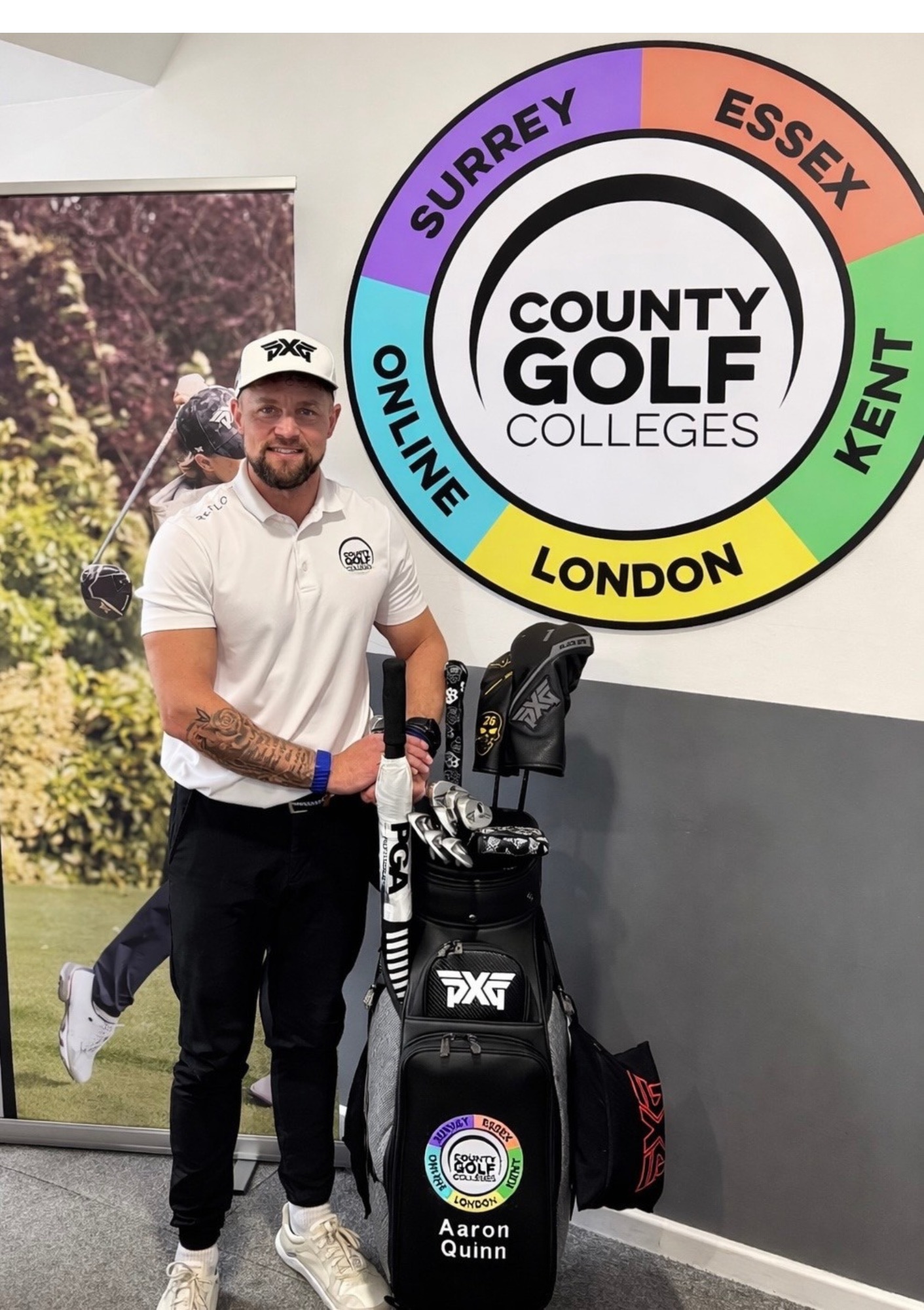


County Golf Colleges founder and PGA Member Aaron Quinn explains how his expanding programme is helping golfers aged between 16 and 18 the chance to combine education, practice and a route into The PGA
When Aaron Quinn set up Essex Golf College in 2020, it was little more than one PGA Professional, a belief in a better pathway and a handful of young golfers who wanted to keep studying without putting their ambitions in the game on hold.
Six years on, County Golf Colleges has grown into a four-site operation across Essex, London, Kent and Surrey, offering 16-18-year-olds the chance to develop their golf while working towards a Level 3 sports qualification.
Quinn identified a long-standing gap that exists between school, elite amateur golf, university routes and PGA training. He believes that clubs, coaches and students can all benefit from a more joined-up approach.
For anyone wondering how the next generation of golfers can combine education, practice, competition and career planning, it is a look at a pathway designed to let them choose both.
“I didn't really have a plan of making this national or anything like that,” said Quinn. “But I already knew that there was a need for it because 16-to-18-year-old golfers didn't have a golf option and a clear pathway. I set it up because I had the experience and knowledge from the education and golf side of things while recognising that students needed to choose between education and golf really.
“The typical route would have been going into a sixth form, sitting in a classroom for 30 hours a week and not being able to dedicate themselves to golf or just play golf all day and leave education at 16. So that was the main niche and reason it's grown.”
Here, Quinn outlines the thinking behind County Golf Colleges, the structure of a typical week, the academic and playing standards involved, the link with The PGA and the opportunities now opening up through online learning and club partnerships.
Who the programme is built for
A student can't begin their PGA qualification until they are 18 and they can't go to America until they're 18. So, there is that gap there. It's a Level 3 qualification which is designed to lead on from passing a Level 2 which is basically a GCSE, particularly in English and Maths but other subjects as well.
We take on plenty of students who haven't quite reached that and they continue to work on their English and Maths while they're with us.
From a golf standpoint, I always tell students the story that I didn't start playing until I was 16. I got down to plus one when I was 19, did my PGA training, turned Pro and made my life from golf.
We know that the potential for development is enormous. We have had dozens of students who started off a handicap of 18, got down to scratch and then did their PGA training or went to the States.
Also, we don’t look too closely at their handicaps as I don’t really think the system is ideal and I don't want to add further fuel to people manipulating the handicaps to get in. We specifically don't look at that. If we are oversubscribed, we just do a testing day where we will test all the skills of golf, take their GCSEs into consideration and we’ll do an interview as well where we can assess the character of the students.
Inside a week at golf college
The students are on-site four days and then have a home study day. A typical week will be classroom, theory lessons, technical, performance coaching, strength and conditioning and on-course work.
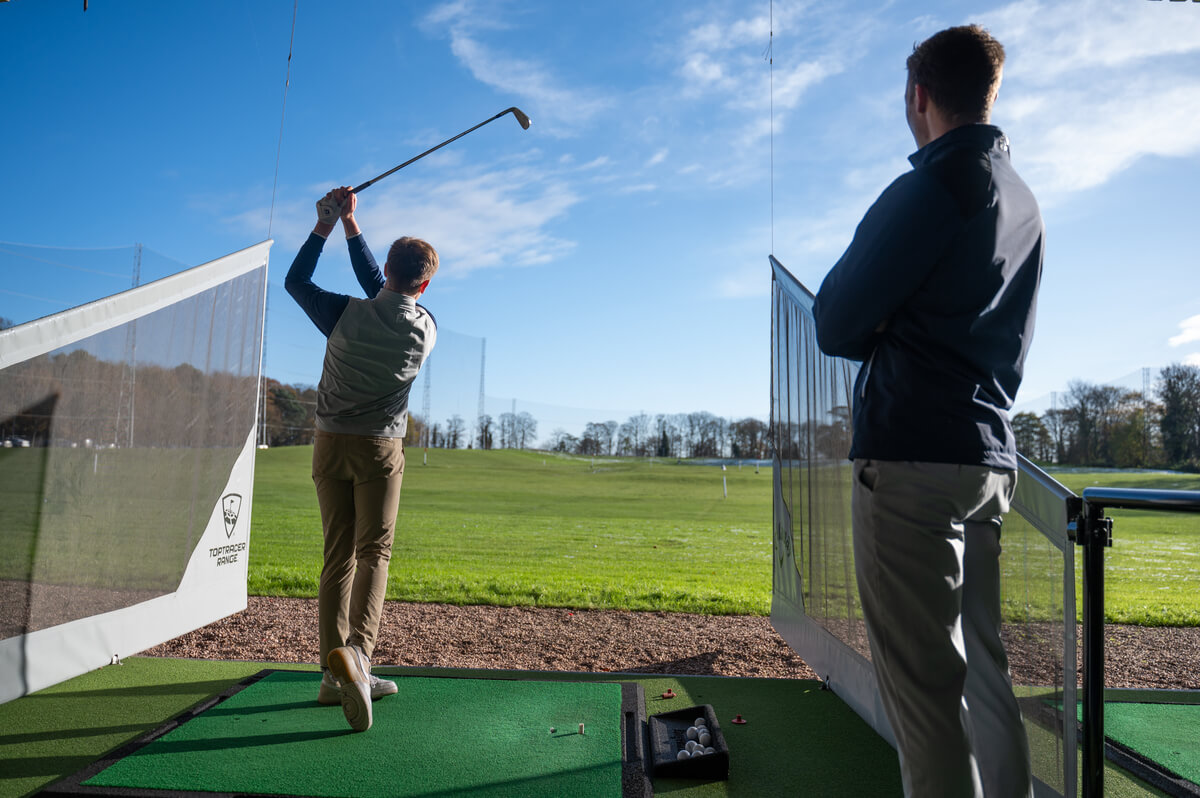
The unique side of it is that, because we are based at golf clubs, outside their structured time with coaches, they've got a golf club in their hand as much as possible. When you look at the 10,000-hour rule, it’s pretty obvious, really. The more you can get a club in their hands, the quicker they’re going to get better.
We've got incredible teams at all the sites with a full-time academic staff member and then at least two coaches who work with the students in small groups as well, delivering our innovative, standardised training programme, which has been proved to work extremely successfully.
Pictured: Aaron ensure the students spend plenty of time on the course
Preparing students for The PGA pathway
The academic programme and training is written specifically for golfers. The qualification is an NCFE Level 3 Extended Diploma in Sport, it carries UCAS points and is broadly equivalent to three A levels.
But it is specifically written from a golfer's perspective and the units themselves that have been picked are specifically for golf and for progressing on to The PGA.
It's really aligning with how the students are sitting there thinking: this is either helping my game or it's really preparing me to work within the golf industry.
Golf is the best sport to be involved in if you want to work within a sport. If you're a good footballer and you don't make it, 95 per cent of them are going to struggle to be involved in that sport. Whereas if you don't make it as a golfer playing-wise or you’re interested in another aspect, then that’s very possible. I say this all the time: The PGA will open up all sorts of doors.
A student can leave school loving golf but have that lack of understanding of what working in the industry actually looks like. We have the job of narrowing that gap between being good at golf and then understanding what it actually would entail to work in the sport.
Our students gain experience in coaching, communication, performance analysis and they're at a golf club all day so they're seeing the environment on a daily basis.
They’re making an informed decision and they have a good understanding of what being a PGA professional is about. We want our students to arrive at their PGA qualification with their eyes open and their foundations already in place.
Why coaching young golfers brings fresh rewards
I still remember what I was like at their age and the passion you have and how it just grabs you. I spent most of my coaching life working with middle-aged guys who aren't going to practise and are not getting physically better, now you’re getting these kids in and they're getting bigger and stronger and they're practising, so that gives myself and the staff great enjoyment and satisfaction.
I also have a real interest in the business side of things and growing that. I'm constantly thinking 'how can we improve the experience?' For example, in recent years we've become involved with PXG and have added in a three-week residential winter training camp in La Manga.
The basic ethos is what would I want if I was 16 again – if you stick to that, everything else will fall into place.
Taking the college model beyond its sites
Essentially, the online programme is for anyone who can't realistically get to a site and we’ve just finished our first two-year cycle of online students. It's opened up our programme to people around the country and I would say the typical person is the better player, who is looking to have the ultimate flexibility to play, practise and compete.
Some of our students have chosen to go and live in different countries and still study with us. When they do the online programme, they can pretty much be full-time golfers and then they work on our programme on an evening or a weekend or when the weather's bad.
It's really freed up people to do that and it's something I'm going to push now that we've had two years and we’ve proved the concept.
It is also about making the PGA coaches aware as well that they can create their own hybrid academies where the player could sign up to the online golf college that we do, work with our online tutors, be at the golf club every day and the Pro could put together a coaching package.
This is something that I really want to get across and how a player can continue and develop with their coach as well as offering something different to the Pro.
We're very flexible with how we can set something up with a Pro and what it might lead to. If we took it as its smallest size and you've got one student who’s leaving school and you put him on this online programme. Then you get a couple more the next year and then you get up to a number where actually, OK, you're going to put a full-time member of staff there and they will do the academics.
What expansion could mean for clubs and students
My goals this year are to add some more site and push the online programme. It's just a case of getting the right fits, the right golf clubs, making contact with these people and showing what we've done at the other places so that students across the UK do not have to choose between academics and golf – they can choose both.
Most of the other sites came about because a student got in touch and said that they wished there was a club closer to them.
It has to be the right type of club, a forward-thinking club that will promote and see the value in developing and having a great academy and pathway to the professional game at their club.
Giving golfers options beyond one route
When I originally set up at the college, it was with a Pearson BTEC, you had a lot of units and it was much heavier on coaching, for example. So that was worth a lot more but we had many students who weren't interested in that side of things.
With the NCFE qualification that we do, every one of the units is worth the same amount of value, so you spend a similar time on it and you don't get out-weighted. We just want to give them plenty of options and they can then decide what they like.
Pictured: County Golf Colleges student Hayden works on his bunker play
Where former students have gone next
The main thing is there's not one single profile student that you need to be to succeed in the industry. We've got some outstanding players who have gone on to win national events and college events in the States.
I recently played in a pro-am at probably our best course in Essex called Thorndon Park. A former student from my very first year group had texted me and said that he had finished his PGA training and that he was looking for somewhere.
I went in and he's there working in the shop at probably our most established private members’ club in Essex. He started off a handicap of 22 and he has worked his way into a fantastic club.
If someone comes in with the right attitude, I'd take anyone and suggest that they could get down to scratch in two years with us. I do firmly believe that, because I've seen it with my own eyes.
Success is about direction, not just scores
The one question I get all the time from parents, quite rightly, is what does this lead to? It's more measured by whether they leave us with direction, confidence and the ability to create a career in golf. So not simply measured by how low their handicap is. I'm on them about what they want to do when they leave us, before they even start with us.
We give them all the progression routes and get them to experience them as much as possible. So they know what they're going to do.
Because as soon as a student locks on to what they want to do, the difference is amazing. And this starts with school – if I speak to a Year 9 or 10 student, and they are really excited about coming to us, then they start to really nail in on their GCSEs.
- Learn more about the programme here.
TESTIMONIAL
Calum Murphy: County Golf Colleges is a great start to doing your PGA qualification
Over the two years I studied at Essex Golf College there where many steps provided to lead me on to doing my Applied Golf Management Degree and PGA qualification at the University of Birmingham. From day one the focus was improving our golf on and off the course, during classroom hours we studied different modules which are similar to theones studied in the PGA qualification which led me to consider this as an option as it seemed as though I already had an insight as top what it would be like.
Out-of-classroom hours consisted of coaching with a PGA Professional, as well as a phycological coach working on all aspects and areas of the game.
Furthermore, getting an insight as to how coaching sessions with small groups of golfers was run and getting a chance to run a demo session on my fellow classmates gave me an idea of what I wanted to get out of college.
The modules studied and the experienced gained from County Golf Colleges is a great start to heading towards doing your PGA qualification.