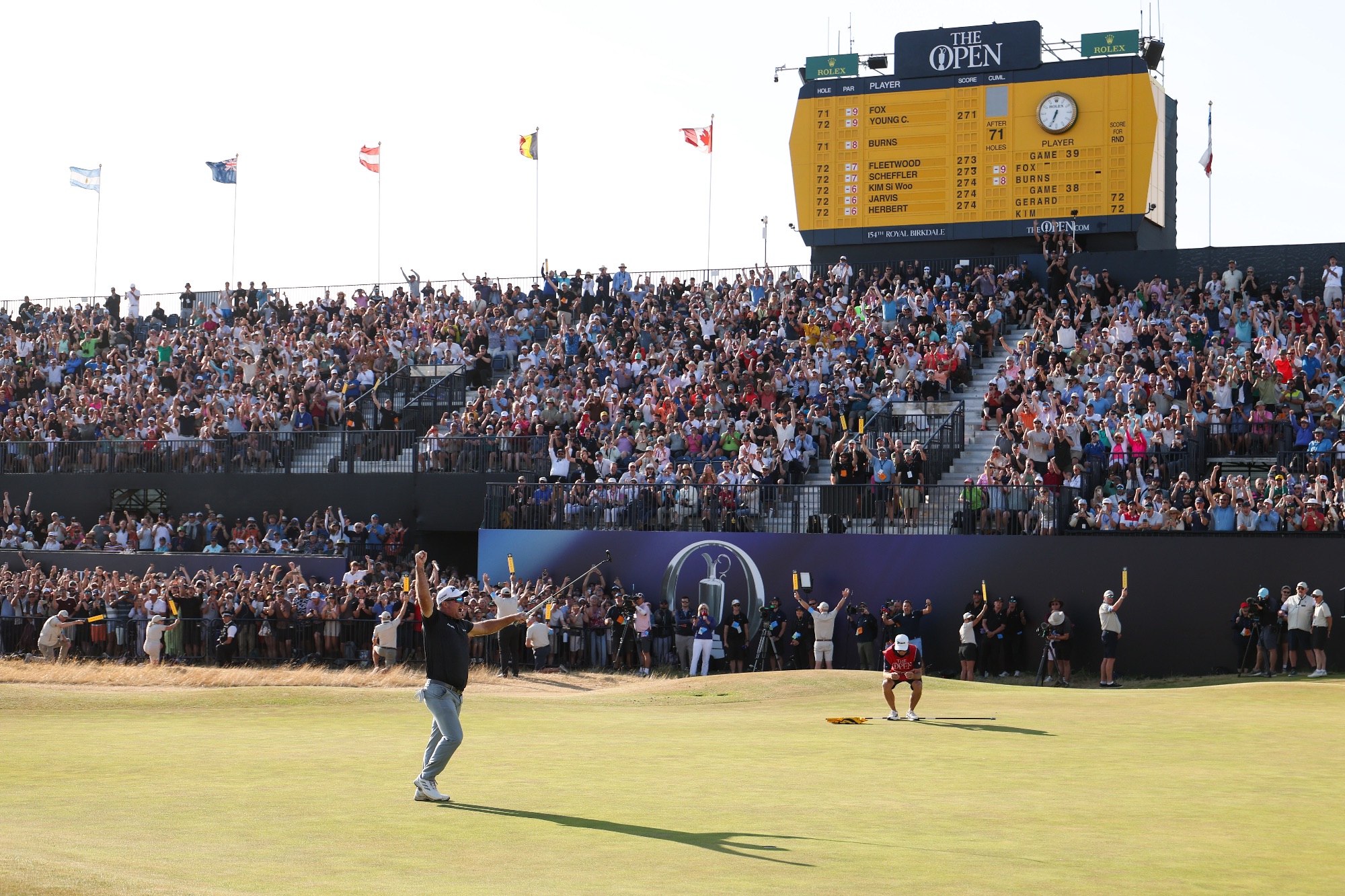


Ryan Fox and PGA Member Karl Morris have exchanged hundreds of phone calls and messages but the one on the evening of Sunday July 19 was particularly special: would you like to drive back to Royal Birkdale to celebrate with the new Open champion?
For seven years Morris has been the performance and mental coach to the New Zealander and now they would get to toast one another with drinks from the Claret Jug.
Morris, who was also behind Louis Oosthuizen’s Open win at St Andrews 2010, had been with the Kiwi at the Scottish Open the previous week and from the Monday to Wednesday of Open week, but he would have to watch from the discomfort of his sofa, along with the rest of us, as the 39-year-old put together one of the great weekends in Championship golf.
On Saturday, Fox shot just the eighth 62 in Major history. He followed it up with an equally brilliant 68 that saw him reel in Cam Young with four birdies – and one of the all-time bogeys – in the closing six holes.
Here, Karl outlines the tools that helped Fox become one of the most popular Open champions in recent times.
Karl with Ryan and his team at Birkdale
How the Fox-Morris partnership began
We began seven years ago. His manager, Ian Keenan, was a good player and he got in touch and said he had this promising player from New Zealand and would I mind having a chat with him. We hit it off straightaway and we would spend a lot of time talking about other sports with his dad, Grant, having played for the All Blacks and his grandfather’s cricketing prowess. He was very open from the word go. We’ve spoken pretty much every week since then and we’ll meet half a dozen times a year in person.
The first time was the ideal. I coach from Delamere Forest which is a great course and we could get out there, walk some holes and that would that would be how I would usually work with a player when I meet them for the first time, away from a tournament. That's really where the plan is established and where they are far more honest and there's less pressure to come up with a quick fix for that week, which I think it's easy to do when you're out there on tour.
Fundamentally, Ryan’s just a decent human being really and I think an awful lot of that has come from his come from his background. It's been a really steady progression. He won four times on the DP World Tour and then twice on the PGA Tour and now a Major so it's certainly not been an overnight sensation. He's just gradually progressed forwards.
The simple idea that unlocked Fox’s clarity
The number one thing, and it sounds so obvious and simple, that we've really looked at over the last couple of years is to create a scenario where it's Ryan Fox against the golf course.
Within that, and we must have had this discussion a million times, is his clarity. When he's really clear on his intention for the shots, then the genius of his body then can take over.
The first conversation I had on the Monday at Birkdale was with Ryan and his caddy, Dean Smith, and they said that it hadn’t been working brilliantly in terms of trying to work out what shots to play. We came up with this idea that Dean was just going to give him the hard data – so it’s 193 to the pin, the wind’s off the right – and Ryan then had to verbalise to Dean the shot he was about to play. They were creating clarity but Ryan would be taking total ownership of the shot. I call it the elusive obvious as it’s so obvious but we don’t do it a lot of the time.
If it’s then a poor shot then it’s an execution error, which then leads into the other thing that we've spent five years talking about – acceptance.
Why good enough is often good enough
Again, a simple word, but a massive subject. The problem that we have with golf is that we play it denying the reality of the game. I'll get people to do an exercise called the 1s, 2s and 3s. So 1 is a good shot, 2 is good enough and a 3 is a poor shot.
I'll get people to do an exercise where they imagine their best round in the last five years. Then they work out how many 3s are still going to be in there and almost everybody puts between five and 15.
I call it front-loading acceptance – it sounds negative but it's not. Before a round a golf, if you actually give yourself a number of 3s, eg six or seven, then the beauty of that is the elephant’s out of the room. So, when the 3s come along, you’ve already predetermined that that's going to happen.
What happens with all good players is that they have a terrible relationship with 2s. So they hit it out of the heel and it's in the fairway, that’s good enough but a lot of good playerswill see that as a 3 and then every round is either a 1 or a 3. So you are just hovering between satisfaction and self-loathing all the time because you don't acknowledge the 2s.
When you can actually acknowledge the 2s as being a good thing – it's not a good shot, but it's good enough – a different world opens up there because you're not you're not denying the reality of golf.
Inside the 62 that changed everything
Ryan knows his game is in good shape when he starts to see his start line. He likes to play a fade most of the time and if his start line is pretty good, slightly left and then falling off, you can see him growing in confidence.
I've never said that skill isn't important. The skill of starting the ball where you want it is a skill I don't think enough golfers look at and Ryan was then able to create that clarity over every shot.
He said he played really well in the second round, his start lines were good and he was just getting much more into reacting to the golf course and then obviously Saturday comes along.
On the Monday we were walking round and it was a bizarre prophecy. Ryan was playing a long bunker shot and his coach, Marcus Wheelhouse, commented that he might be the best long bunker player in the world. Something in his technique allows him to excel in this particular shot and then he played that second shot to the 18th from the sand which was the greatest golf shot I've ever seen. I know I'm biased but to hit the green from 193 yards was incredible and really set him up for that final round.
Karl and Ryan with the Claret Jug
No stories, just the shot in front of him
A theme that we've had for a long time is the idea of ‘no stories’. This means in any situation on the golf course, you're either in one place or the other. You're either creating a story or it's what we call ‘it just is’. You could be out playing and a good tee shot finishes in a divot. You’ve then got a choice of either going into a story of how unlucky you are and how this always happens to you or it just is.
On the 15th, Ryan hit a fantastic tee shot which finished a few inches short of being perfect, to leave himself with no shot in a bunker. That moment highlighted no stories in the sense that he got to it – Dean was brilliant in that situation – had clarity and played it out backwards. Then it culminated in one of the best bogeys maybe ever in championship golf. Ryan didn't create a story – he just dealt with the reality.
Pursuit golf: choosing courage over caution
Ryan and I have talked a lot about attention. What is your attention going to be on? When you're out there playing it's either on something useful or useless. It was still Ryan against the course but then Cam Young posted his 64 to finish on -9 so that’s getting more difficult. Cam is not going to hit another bad shot and the course is getting tougher but Ryan still has to go and beat the golf course.
The other theme we’ve had for a long time is the difference between pursuit golf and avoidance golf. We’ve all fallen into the trap of playing avoidance golf where we're trying to avoid a certain tee shot or bunker shot, and we've all got our own little nemesis.
This idea, and it ties in with acceptance, is to be clear on the shot that you're trying to play and then just pursue that good shot. This is where acceptance is so important – you can only pursue the good shots if you're willing to accept the poor ones.
The tee shot on 18 on Sunday summed it all up where Ryan said to Dean that he was going to hit driver, knowing that might mean a bogey, but let's go and try and win this rather than just settle for a play-off.
My analogy of that 18th tee shot at Birkdale was trying to imagine that you've got to hit a tee shot down your driveway in a left-to-right wind – that was a perfect example of pursuit rather than avoidance golf.
What coaches can learn from Fox’s breakthrough
If somebody wants to get better at golf, they need to do two things – they need to develop specific skills in their game and they need to access their skills.
We've focused a lot just on the swing and the swing is not the skill. Performance coaching, and the accessing of your skills, is where you can develop a great one-to-one relationship with the player. Perhaps in the future more coaches will spend more time on the course with their lessons. Maybe taking two or three out in a group and seeing why somebody is not accessing the skills on the course will become seen more.
We are the only sport, as far as I know, where the coach might not see the player play the sport. Can you imagine a football manager never watching his team play and then saying on Monday morning, how did you play on Saturday?
There are huge possibilities for a PGA Professional to work with their players in different ways and that is very exciting.