

Having introduced the recent updates to The PGA’s coaching qualifications and discussed the importance of coaching the person first through the 4C’s framework, David Colclough, Head of Coaching and Sport Science, explains the contents and thinking behind our current coaching qualifications as we seek to equip the next generation of PGA Coaches
This third article in our series focuses on the technical framework that underpins the coaching element of The PGA training programme. Most of you will have encountered it before, but the real question is: how often does it consciously inform your coaching?
To read part two of the evolution of the coaching qualification, click here.
For all the advances in coaching, technology and sports science, it is worth asking an uncomfortable question:
To what extent has golf coaching really moved beyond the idea of a “correct” swing?
The language of individuality is now commonplace. Yet in practice, many coaching interventions still drift toward how a swing should look, rather than what it needs to achieve. The persistence of model-based thinking may not be explicit, but it remains influential.
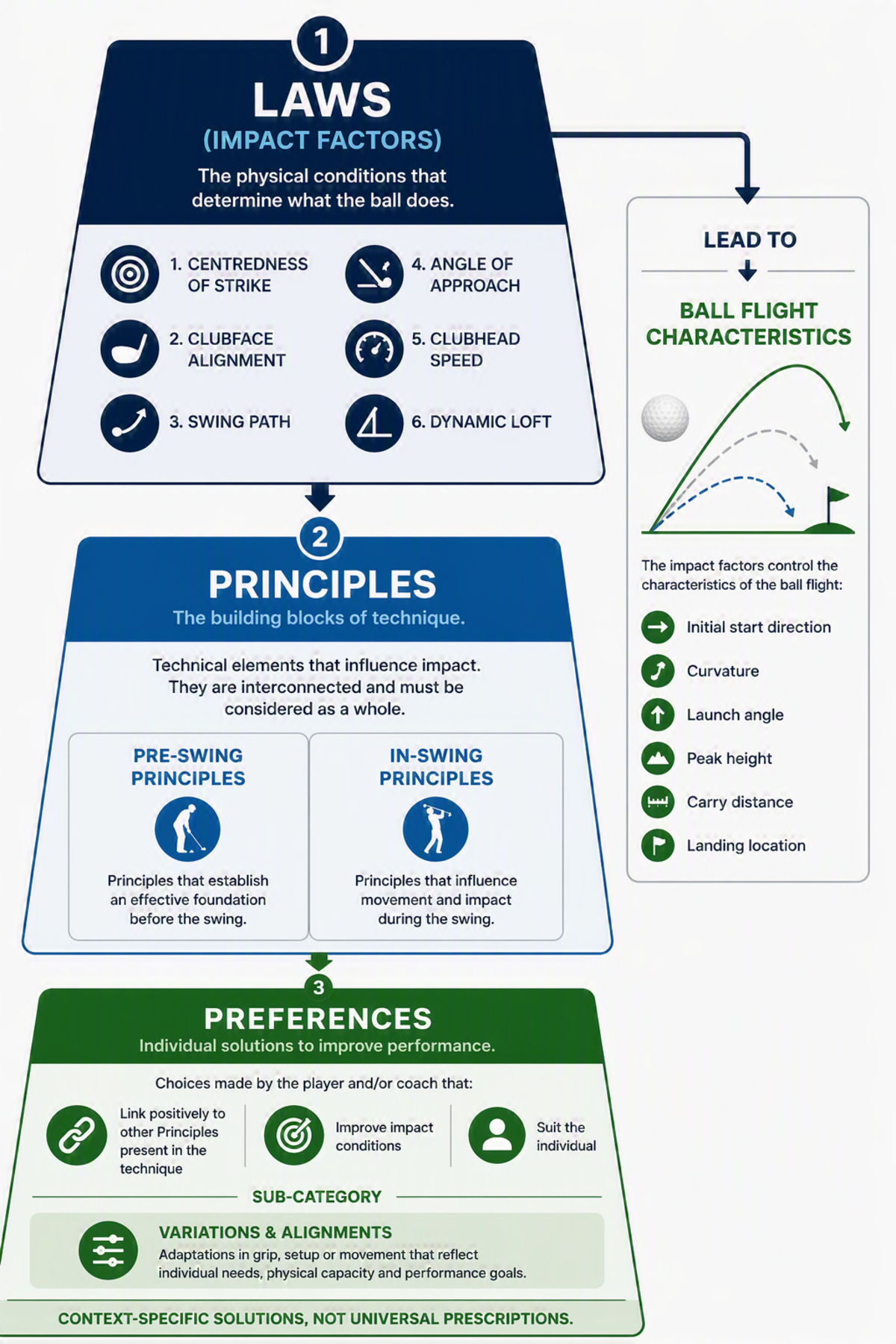
The PGA’s Technical Coaching Framework (TCF) is based heavily on the Laws, Principles and Preferences model (1) first proposed by Dr Gary Wiren back in 1990. It does more than offer another way of organising information. At its core, it challenges a fundamental assumption still present in coaching: that performance can be built by moving players closer to a preferred technical model.
From Idealised Movement to Functional Outcome
The purpose of the golf swing is often taken for granted. Yet how a coach answers that question shapes every intervention they make.
If the aim is to reproduce a specific movement pattern, then coaching becomes an exercise in correction—moving players toward an external standard. But if the purpose of the swing is understood as producing the appropriate impact conditions for the shot at hand, then technique can no longer be treated as an end in itself.
This distinction is not trivial. It represents a shift from:
- Evaluating movement by appearance
- To evaluating movement by consequence
As John Jacobs (2) articulated:
“The only purpose of the golf swing is to move the club through the ball square to the target at maximum speed. How this is done is of no significance at all, so long as the method employed enables it to be done repetitively.”
Modern interpretation extends this further: the swing must produce variable outcomes under changing conditions, not just repeat a fixed pattern.
The implication is difficult to ignore:
If performance is defined at impact, then any approach to coaching that prioritises movement form over impact outcome is fundamentally misaligned.
"If the purpose of the swing is understood as producing the appropriate impact conditions for the shot at hand, then technique can no longer be treated as an end in itself"
The Enduring Influence of the ‘Model Swing’
Few coaches would openly advocate for a single ideal swing today. Yet its influence persists in more subtle ways:
- Swings are still frequently judged by how closely they resemble accepted norms
- “Faults” are identified without always considering whether they are functional
- Technical changes are prescribed before impact conditions are fully understood
This is not a failure of knowledge, but perhaps a reflection of comfort. A model provides certainty. It offers a clear direction and a sense of control.
But it also introduces risk.
Two golfers can produce similar impact conditions through very different movements. Equally, two swings that look similar can produce very different ball flights. When visual conformity becomes a reference point, coaches may inadvertently prioritise how a swing looks over what it actually does.
What the PGA’s TCF Framework Really Demands
The PGA’s TCF is a framework for decision-making under uncertainty.
At its simplest, it asks three questions:
- What did the ball do?
- What caused that at impact?
- What should change to improve the result?
This sequence is deceptively straightforward. Its significance lies in what it removes:
- It removes the assumption that a movement is wrong because it looks different
- It removes the idea that there is a single correct solution
- It removes the temptation to intervene before diagnosis
Instead, it places impact and ball flight at the centre of all coaching decisions.
Laws: What Cannot Be Negotiated
The Laws—impact factors—are governed by physics. They define what the ball will do.
- Centredness of strike
- Clubface alignment
- Swing path
- Angle of approach
- Clubhead speed
- Dynamic loft
These are not theoretical constructs. They are the non-negotiables of performance. The ball does not respond to intention, aesthetics or coaching preference—it responds to these conditions.
Yet this raises an important point:
If all golfers are subject to the same laws, why do they not—and should they not—move in the same way?
Principles and Preferences: Where Coaching Becomes Complex
If the Laws define outcomes, the Principles and Preferences define how those outcomes are achieved.
Principles—grip, setup, balance, movement—provide structure. But they do not prescribe a single solution. They are interdependent and context-sensitive.
Preferences go further still. They are often misunderstood as stylistic choices. In reality, they are solutions shaped by both task demands and individual constraints.
Treating them as universal prescriptions risks replacing one model with another—only less explicit.
This leads to a critical implication:
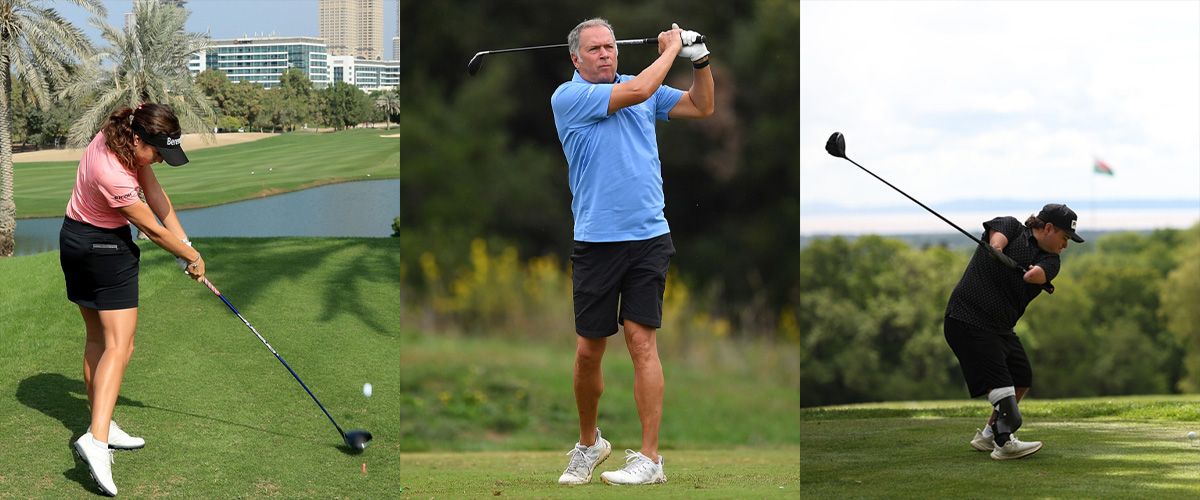
There is no technically correct way to swing a golf club—only solutions that are more or less effective for a given individual producing a given outcome.
The Overlooked Constraint: The Player
Perhaps the most significant challenge The PGA’s TCF presents is the need to fully account for the golfer themselves.
Players do not arrive as blank canvases. Rather, each individual possesses a unique combination of physical and mental characteristics and capacities that interact with the environments, experiences, and opportunities that shape their development in golf.
Focusing specifically on the physical dimension, each person brings their own:
- Mobility and range of motion
- Strength and power capabilities
- Injury history
- Occupational demands
- Age-related change
- Disability or impairment
These factors are not secondary considerations. They are active constraints that shape movement.
A player with limited thoracic rotation will not simply adopt the same sequencing strategies as a highly mobile athlete. A golfer with reduced lower-body stability will organise movement differently. A wheelchair golfer will produce entirely different patterns while still creating effective impact.
The implication is difficult to avoid:
If movement solutions are constrained by physical capacity, then prescribing a preferred pattern without accounting for those constraints is not just ineffective—it may be inappropriate.
When ‘Faults’ Are Actually Solutions
A consequence of this perspective is that coaches must reconsider how they interpret technical “errors”.
What appears to be a fault may in fact be:
- A compensation for a physical limitation
- A learned adaptation that stabilises performance
- Or a functional behaviour that supports impact
Without understanding the constraint landscape of the player, there is a risk of removing behaviours that are central to their solution.
This introduces a subtle but important shift:
The role of the coach is not to eliminate deviation—it is to determine whether that deviation is functional.
Function Before Style—But Not Without Tension
The idea that “function should precede style” is widely accepted. The challenge lies in applying it consistently.
It is one thing to accept that different swings can work. It is another to:
- Resist the urge to normalise movement
- Accept unconventional solutions
- Tolerate variability in pursuit of function
This requires a level of restraint in coaching that is not always comfortable.
If coaching decisions must account for:
- Impact conditions
- Movement interactions
- Physical constraints
Then the role of the PGA Professional necessarily expands.
It requires the ability to:
- Interpret ball flight objectively
- Recognise physical limitations and capabilities
- Integrate technical and physical considerations
- Make context-specific decisions rather than apply default solutions
This is not simply a change in tools. It is a change in how coaches think.
The Challenge Moving Forward
The continued relevance of the Laws Principles and Preferences model, through the PGA’s Technical Coaching Framework, does not lie in its structure, but in what it asks of coaches.
It challenges:
- The residual influence of model-based thinking
- The bias toward visual assessment
- The tendency to prioritise correction over understanding
It also exposes a gap between theory and practice.
It is easy to agree that there is no single way to swing a golf club. It is more difficult to coach in a way that fully reflects that belief.
If coaching is truly individualised, impact-led and constraint-aware, then any residual reliance on a preferred model—explicit or implicit—becomes increasingly difficult to justify.
For PGA Professionals, the question is no longer whether the framework is valid.
It is whether its implications are being fully accepted—and consistently applied.
References
1. Wiren, G. (1990) ‘The laws, principles and preferences of teaching golf’, in Cochran, A.J. (ed.) Science and Golf: Proceedings of the First World Scientific Congress of Golf. London: E. & F.N. Spon, pp. 3 – 13
2. Jacobs, J. with Ken Bowden (1972) Practical Golf. London: Stanley Paul & Co. Ltd.
To read part two of the evolution of the coaching qualification, click here.