

Image Credit: Scottish Golf
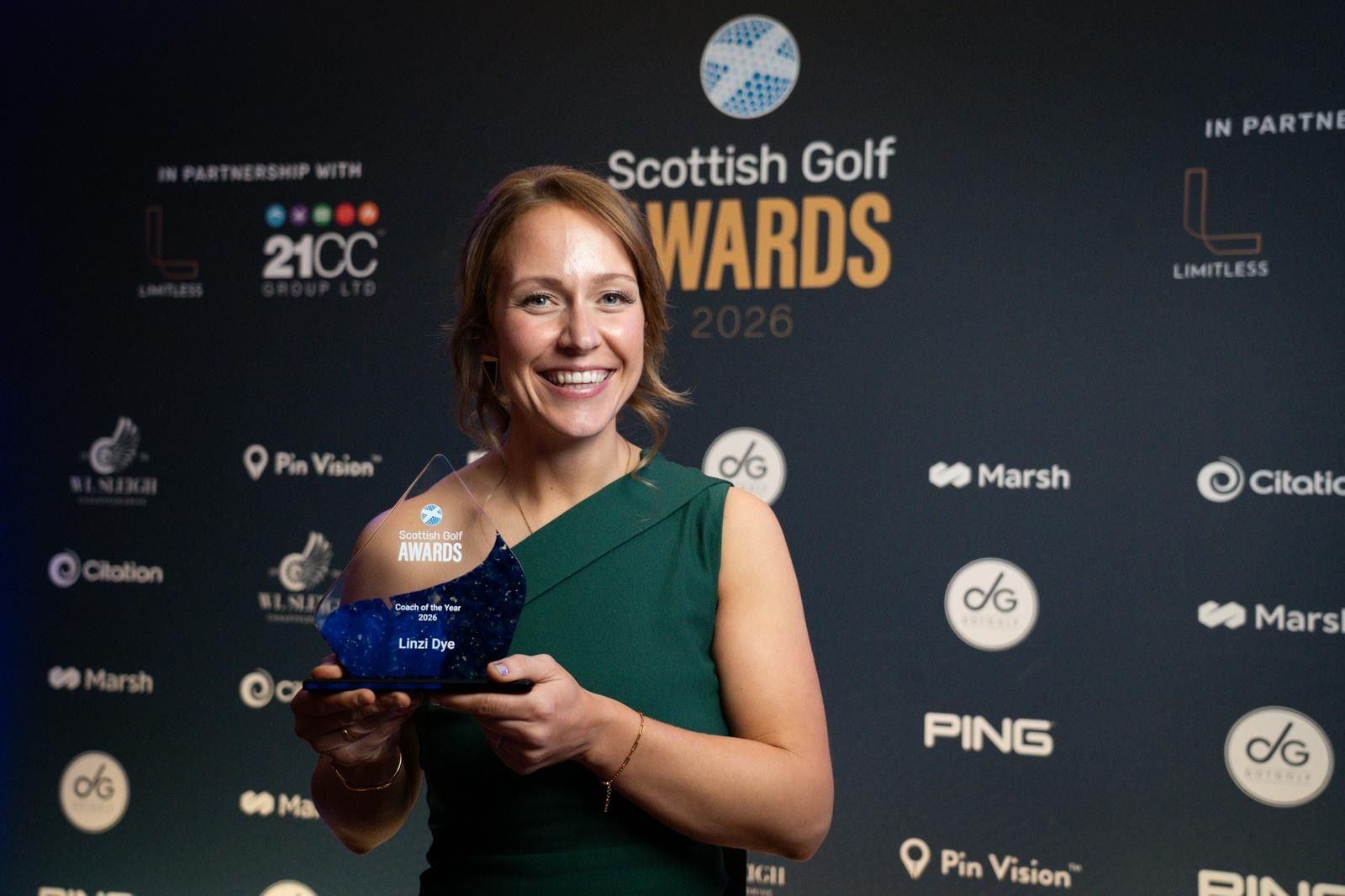
The Coach of the Year award takes pride of place in Linzi Dye’s house. Well, in a fashion. “It’s sat in a spot that’s out of reach for my three-year-old,” she chuckled of this tempting trinket for the inquisitive touch of a toddler.
Dye’s success at the recent Scottish Golf Awards was a rich reward for the enthusiasm, energy and endeavour of the West Kilbride PGA Professional as she topped a keenly contested category which also included her fellow members of the association, Alastair Forsyth and Tiffany MacKenzie.
“I didn’t expect to make the final three let alone win it given the other talented coaches that were in for it,” admitted the modest 34-year-old.
“As a coach you don’t do this for any accolades. I don’t anyway. I just do it because I love it. I just want to bring more people into golf and change the environment while helping to future proof the club.”
Dye is certainly doing her bit on those various fronts. Through the love.golf initiative, the on-course group coaching programme designed specifically for women, she has encouraged and inspired a variety of females to take up the game while creating a pathway to membership which has had spin-offs for her home club.
“Our ladies section was shrinking quite badly,” admitted Dye. “The age demographic was a challenge too. That’s quite common at clubs.
“When you looked at the numbers on paper, it didn’t look bad but when you looked at the actual number of women who played, it was pretty poor and many were not overly active.”
Changing a golfing culture is not an easy task but, as maternity leave loomed, Dye’s persistence paid off. This passion and perseverance clearly impressed the award judges.
“I tried to get different incentives into the club to encourage women in,” added Dye, who was a student at Newman University in Kansas before returning to her homeland and embarking on her PGA training under the shrewd tutelage of Iain Darroch at West Kilbride.
“You tend to hit various roadblocks and things would take a long time. I tried to push new membership categories but one of them got kiboshed on the basis of positive discrimination. If it wasn’t offered to men it couldn’t be offered to women.
“At the time I was about to go on maternity leave, I had 20 active women in my love.golf programme and I was worried about what they’d do when I wasn’t there for a few months.
“We had to do something. We have a social membership at West Kilbride so we attached a basic playing right on to that. You basically got a year to access the course during really quiet times.
“It wasn’t for playing in competitions or getting handicaps. It was just about giving them access to the course and creating a wee stepping stone so they could experience golf on their own terms. I went on my maternity leave at least knowing I had people there.
“We got a new secretary, who is now general manager, in. I basically pleaded with him and said, ‘give me another year of this, we just need a bit more time and we’ll get them in as full members’.
“He agreed. Out of 17 on the pathway, I got 14 joining as full members which was amazing. We now have a pathway in place towards membership. I have 31 women on the pathway across year one and two. Not all of them will join, but if it drip feeds our female membership for a few years to come, our section will be in a much better place.”
The refreshing, relaxed love.golf ethos, allied to Dye’s easy-going expertise, provides a wonderfully warm welcome to a game that, for a tentative new recruit, can often be intimidating.
“I say it all the time to the people who come to me; ‘just give it a go and see what happens’,” said Dye. “From there it’s about them answering questions. Say for example they are missing the ball, then you ask them why they think they are doing that.
“Where is the club? Is it missing over the top? The left, the right? You lead them to an answer and they’ll self-connect in a way that eventually makes them hit the ball.
“The big hook of the programme is getting them straight on to the course. They are then able to put golf into context very early on in their journey. It takes away the pressure of the big build up towards actually going out on the course after weeks on a range.
“I had a taster session and I had 17 women out on the course. To a casual observer it looks like chaos and a bit loud but it’s fun and it works. Obviously, there are times when I have to step in and give some technical advice but it’s more about self-discovery.
“It’s about letting them take a bit of ownership of their development. There’s no one size fits all model in golf. Everyone moves differently depending on their background. If they have zero sporting background, it’s a tough game to pick up.
“They will move totally differently and will have less special awareness than say someone who has always played sport. And that’s fine.
“You just have to tailor your approach to help them make contact with the ball, get it going forward and into the air. At the end of the day, we’re giving them a hobby. If they like that then they’ll keep doing it.”
By her own admission, Dye was never going to make a living playing tournament golf. “I didn’t have the killer instinct you need to be a touring pro and I don’t think I would’ve handled the stress that it involves,” she conceded.
Coaching, though, has provided tremendous fulfilment and The PGA badge is one that she treasures. Dye doesn’t take her status as a fully qualified professional for granted either.
“I’m going through The PGA Excel framework as I think it’s important to keep learning,” she said. “Our industry moves so quickly. You must stay on top of everything or you get left behind.
“It’s about being accountable. Just because you have your PGA qualification that shouldn’t be the end of the journey. It should be the launchpad towards the next chapters of your career.”
The other platforms offered by The PGA as a means of promotion and connection continue to help Dye spread her golfing gospel.
The PGA Play facility, for instance, offers plenty of opportunity for expansion. “If a potential client comes through PGA Play, I’ll respond within 24 hours,” she said of the importance of a prompt acknowledgement. “I’ll then send them a link to my lesson diary so they can click on it and find something that suits them.
“I am generally interested in people. I want to know why people are coming, why they are picking up a club for the first time or what’s their motivation for getting better. I get invested in the person first and then the golfer.
“In an ideal world, at the end of a lesson, you’d ask them if they want to book in again. But I’ll always send them the lesson notes of the day so they have all the feedback they need. They are not going away empty handed.”
The proliferation of golfing pearls of wisdom available on social media, meanwhile, can be a help and a hindrance.
“People can be much more informed but there are challenges with that,” said Dye. “Things on Instagram or TikTok may not be relevant to a client as an individual. I remind mine of that a lot.
“The client says they have watched some lesson on social media but I’ll say that the person online has no idea how you swing and how you move and what they are saying may not help you.
“It’s a saturated space online. It can be overwhelming. Even as a coach it’s almost too much.”
As well as juggling her golfing duties with motherhood, Dye remains an important voice on The PGA in Scotland committee.
“I’m female, I’m younger and I can give a different perspective,” added Dye, who has been joined on the committee by Lesley Mackay. “Our challenges are different to the ones faced by men.
“Going on maternity leave, for instance, makes you worry about losing clients when you step away for eight months or so. You feel like you might be starting from scratch again. Perhaps that’s why we still don’t see that many female head pros?
“If a club is looking to recruit a female, there may be concerns about her starting a family and how it pulls her away from being a pro.
“For me, having a child gave me the kick I needed to prioritise my time. I was doing a lot of shop-based hours before maternity leave. When I came back, I only did 20 hours and balanced that out with coaching. I cut it to 10 hours and now I’m not in the shop at all.
“Hopefully, one of the benefits of me being on the committee is that others in a similar boat can come to me and use me as a sounding board.”
Dye will be a canny person to seek advice from. She is Scotland’s Coach of the Year, after all.